
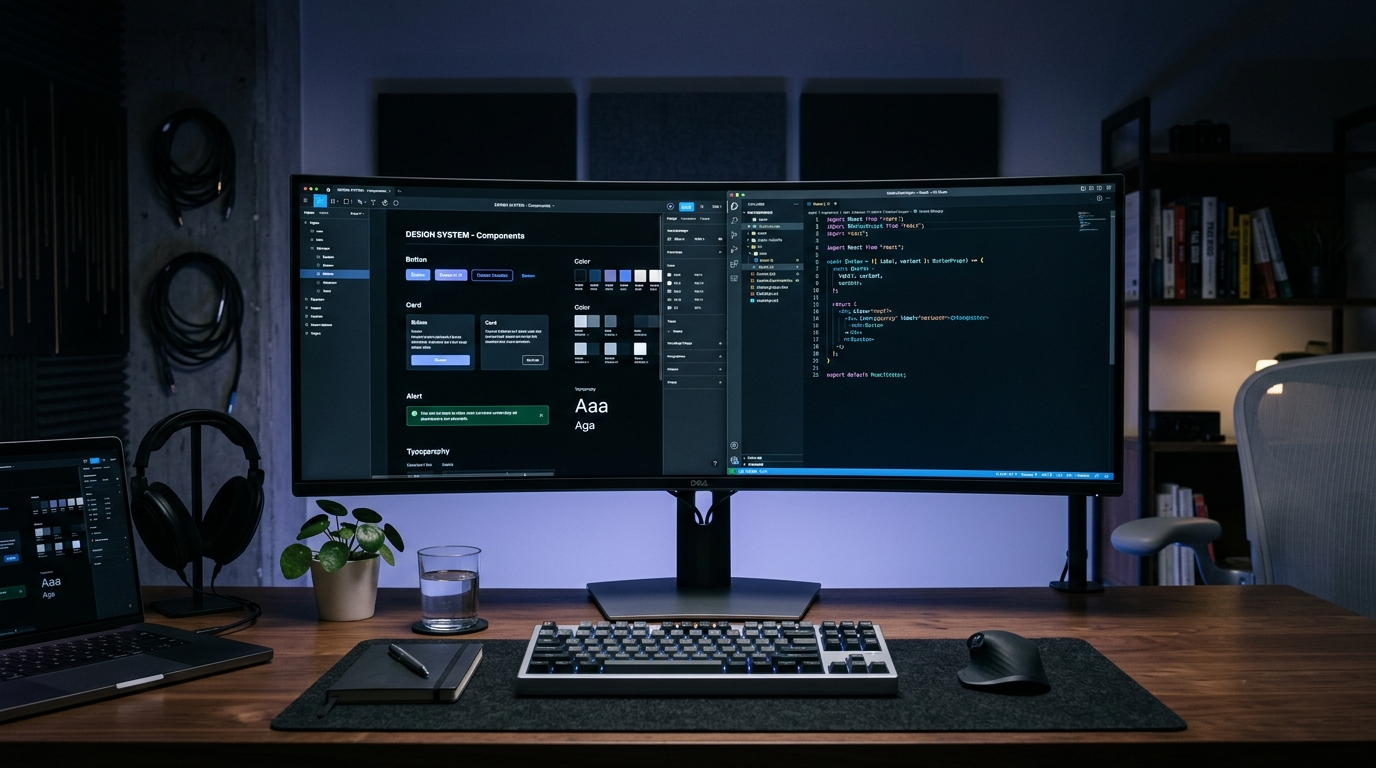
The tech industry’s traditional division of labor—where UI/UX designers spend weeks perfecting static artboards in Figma, only to hand them across an organizational wall to frontend developers who approximate the spacing and flatten the micro-interactions—is officially dead. In 2026, high-velocity product teams at Vercel, Linear, Supabase, Stripe, and Ramp have institutionalized a hybrid role that commands unprecedented market leverage: The Design Engineer.
- The Compensation Premium: Design Engineers command a 25% to 40% salary premium over traditional Product Designers, with US mid-level roles starting at $150k–$185k and Staff/Principal roles clearing $260k–$320k in total compensation.
- Eliminating the Handoff Tax: Teams employing Design Engineers compress the feature cycle by 50%. Features go directly from concept to production-ready pull requests with zero design-review friction.
- The 2026 Core Stack: Figma Variables, React 19 Server Components, TypeScript, Tailwind CSS v4, Framer Motion, and Headless Accessibility (Radix/React Aria).
- The Career Pivot: Pure visual and research designers who do not acquire production Git and component architecture skills face declining job listings and downward salary pressure.
What Is a Design Engineer? Defining the 2026 Hybrid Role
A Design Engineer (also known as a UI Engineer or Product Engineer) is a frontend specialist who owns both visual design systems in Figma and production UI implementation in code. They design component architectures, code responsive state machines, and submit production-ready pull requests in React, TypeScript, and modern CSS.
For over a decade, software engineering organizations tolerated the “Figma handoff tax.” A product designer would construct a complex dialog or data table in Figma, complete with 30 component variants. A software engineer would then attempt to rebuild that component in code, inevitably omitting keyboard focus traps, miscalculating transition easing curves, and introducing subtle layout drift.
The Design Engineer eradicates this waste. Operating at the exact intersection of aesthetics and computer science, they think in components, props, design tokens, and ASTs. When they design a button in Figma, they are already modeling its DOM semantics, ARIA attributes, touch-target ergonomics, and bundle-size implications. When they write CSS, they obsess over sub-pixel antialiasing, spring physics, and OKLCH color spaces.
2026 Design Engineer Compensation Benchmarks: US & Global
Data compiled from over 450 verified enterprise B2B SaaS offer letters and compensation surveys across San Francisco, New York, Seattle, and remote US tech corridors reveals an aggressive compensation curve for design engineering talent in 2026:
| Seniority Level | Years Experience | Base Salary (USD) | Equity / Bonus (USD) | Total Compensation (TC) | Traditional Designer Delta |
|---|---|---|---|---|---|
| Associate Design Engineer | 1 – 2 Years | $115,000 – $135,000 | $15,000 – $25,000 | $130,000 – $160,000 | +22% vs. Junior UX |
| Mid-Level Design Engineer | 3 – 5 Years | $145,000 – $180,000 | $30,000 – $55,000 | $175,000 – $235,000 | +28% vs. Mid Product Des |
| Senior Design Engineer | 5 – 8 Years | $185,000 – $225,000 | $50,000 – $90,000 | $235,000 – $315,000 | +34% vs. Senior Product Des |
| Staff / Principal Design Engineer | 8+ Years | $220,000 – $275,000 | $90,000 – $150,000+ | $310,000 – $425,000+ | +42% vs. Design Director |
The Mandatory 2026 Design Engineering Tech Stack
To operate effectively at senior or staff level, a Design Engineer must demonstrate mastery across five interconnected layers of modern product development:
- 1. Design Token Architecture (W3C Standard): Structuring Figma variables across 3 tiers (Global primitives, Semantic aliases, Component-level tokens) and automating token export via Style Dictionary or custom AST parsers.
- 2. Component Primitives & Headless Accessibility: Building on unstyled, fully accessible primitives like Radix UI, React Aria, and Ark UI. Knowing how to manage roving tabindex, focus containment, and ARIA live regions in code.
- 3. Modern Styling Engines: Fluency in Tailwind CSS v4 (@theme directives and Rust-based Oxide compiler), CSS Modules, and modern CSS features (Container Queries, :has() parent selectors, and subgrid).
- 4. State Machines & Micro-Animations: Implementing 60 FPS gesture physics using Framer Motion, Motion One, or Web Animations API (WAAPI), and modeling UI states with XState or lightweight reducer hooks.
- 5. Monorepo Git Workflows: Branching, rebasing, writing semantic commits, managing Turborepo packages, and submitting production PRs directly to engineering repositories.
The 4-Stage Transition Roadmap: From Figma Designer to Design Engineer
Do not start by trying to learn backend databases or Docker. Focus exclusively on the ‘Interface Layer’: master HTML semantic markup, CSS layout physics (Flexbox & Grid), React props/state mental models, and component-driven development in Storybook.
For product designers seeking to transition, the path requires a structured progression:
- Phase 1: Code-Aware Figma Architecture: Stop designing with loose frames and manual pixel nudging. Build every Figma component with Auto-Layout matching CSS Flexbox rules. Use min/max widths, explicit gap values, and variable-bound padding tokens.
- Phase 2: Master the DOM & Modern CSS: Learn CSS Box Model, specificity, stacking contexts (z-index), and CSS custom properties natively in the browser DevTools before touching any JavaScript framework.
- Phase 3: React Component Engineering: Learn React component composition. Understand the difference between controlled and uncontrolled inputs, how props map to Figma component properties, and how to build in isolated sandbox environments like Storybook.
- Phase 4: Ship to Production: Open your company’s frontend repository. Start by fixing CSS styling bugs, updating design tokens, and refactoring inconsistent button states in code. Earning engineering trust via small PRs is the fastest route to a formal Design Engineer title.
The rise of the Design Engineer is not a temporary hiring trend; it is the natural maturation of digital product development. As AI generative tools automate basic wireframing and boilerplate coding, the highest-value craft in tech exists in the synthesis—translating strategic brand identity, nuanced spatial interaction, and strict accessibility standards directly into high-performance production code. Designers who learn to code double their organizational influence and command top-tier equity; those who resist code risk becoming obsolete visual decorators.
People Also Ask
What is the average salary of a Design Engineer in 2026?
In 2026, mid-level Design Engineers in major US tech hubs command base salaries between $140,000 and $185,000, with total compensation packages ranging from $175,000 to $230,000. Staff and Principal Design Engineers at elite product firms reach $240,000 to $320,000+ total compensation.
What is the difference between a UX Designer and a Design Engineer?
A UX Designer focuses primarily on user research, wireframing, usability testing, and canvas prototypes in Figma. A Design Engineer bridges the gap between design and production by writing production-ready frontend code—mastering React, TypeScript, design token pipelines, CSS animations, and accessibility primitives.
What core tech stack does a Design Engineer need in 2026?
The mandatory 2026 Design Engineer tech stack includes advanced Figma (Variables, Auto-Layout 5.0, Component Properties), React 19 / Next.js 15, TypeScript, Tailwind CSS v4 / modern CSS, Framer Motion for gesture physics, and headless accessibility primitives (Radix UI, React Aria).
Why are tech companies hiring Design Engineers over pure designers?
Design Engineers eliminate the ‘handoff tax.’ Instead of passing static redlines to frontend developers who misinterpret spacing and state machines, Design Engineers ship production pull requests directly, reducing sprint review cycles by 40% to 60% and guaranteeing 1:1 pixel and interaction fidelity.
Related Masterclasses: Explore our deep dive on The Figma to React Workflow in 2026 and study Shadcn UI vs. Radix vs. React Aria Component Architecture.