
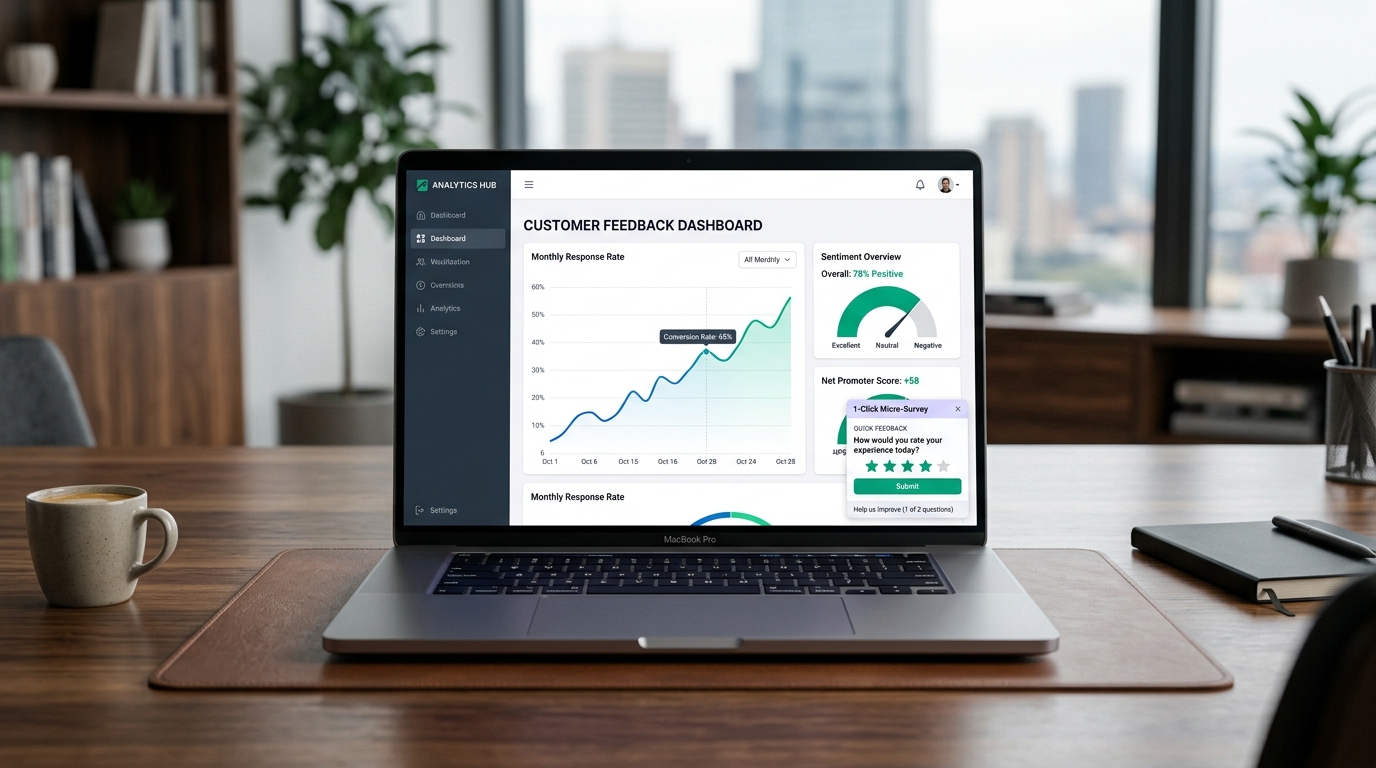
The traditional 20-question customer feedback survey is officially dead. Sending lengthy Typeform links via email yields abysmal 1% to 3% response rates, skewing results toward an extreme minority of outraged or hyper-enthusiastic users. In 2026, leading product-led growth (PLG) teams have replaced asynchronous survey emails with in-app, 1-click micro-surveys embedded directly into the user’s active workflow. When executed with progressive disclosure and contextual behavioral triggers, micro-surveys reliably achieve 55% to 68% completion rates.
How Do In-App Micro-Surveys and 1-Click Rating UX Drive 65% Response Rates?
1. The 3 Golden Rules of Micro-Survey Interaction Design
To capture continuous, high-volume qualitative feedback without alienating your active user base, product designers must adhere to three foundational interaction constraints:
- Rule 1: The Zero-Modal Non-Modal Constraint: Never block the user’s viewport with aggressive center-screen modal popups. Micro-surveys must render as non-intrusive toast notifications, bottom-right slide-ins, or embedded inline cards within completed task screens.
- Rule 2: The 1-Click Initial Commitment: The first step must require only a single click (e.g., Star rating, emoji sentiment scale, or a 2-choice button). Once the user registers their first click, cognitive commitment theory (the Zeigarnik effect) increases the likelihood that they will answer a secondary open-ended text prompt.
- Rule 3: Instant Dismissibility: The close icon (
✕) must be immediately accessible and clear. If a user dismisses a micro-survey, suppress all feedback prompts for that user for at least 30 days to prevent banner fatigue.
2. Contextual Behavioral Triggers: When and Where to Prompt
Timing determines conversion. Blasting users with an NPS survey on their first login destroys user trust. Micro-surveys must be tied to specific milestone achievements and critical product-led activation gates.
For example, deploying feedback prompts during offboarding flows—as detailed in our anti-churn cancellation and pause flow teardown—captures the exact reasons behind churn, allowing product managers to intervene with customized retention offers. Similarly, pairing micro-surveys with B2B onboarding time-to-value milestones ensures that you measure sentiment precisely when the user experiences their initial ‘Aha!’ moment.
3. Closing the Feedback Loop: Integrating Insights into Product Sprints
Capturing 500+ micro-survey responses per week is useless if data sits in an unread spreadsheet. High-growth product organizations pipe raw micro-survey webhooks directly into internal communication tools (Slack channels, Linear project backlogs, PostHog dashboards), categorizing sentiment into immediate bug fixes, usability friction reports, and roadmap feature validations.
People Also Ask
What is an in-app micro-survey?
An in-app micro-survey is a lightweight, 1 to 2 question feedback prompt displayed natively within a web or mobile application, triggered by specific user actions to capture real-time customer sentiment with minimal cognitive friction.
Why do micro-surveys have higher response rates than email surveys?
Micro-surveys achieve 50%+ response rates because they appear in context while the user is actively engaged with the product, require only a single click to submit, and eliminate the friction of opening external email links.
What is the best trigger timing for a customer satisfaction micro-survey?
The optimal trigger is immediately after a user successfully completes a key milestone or core value action (e.g., exporting a report, finishing a project, or finalizing an order), capturing sentiment during peak satisfaction.