
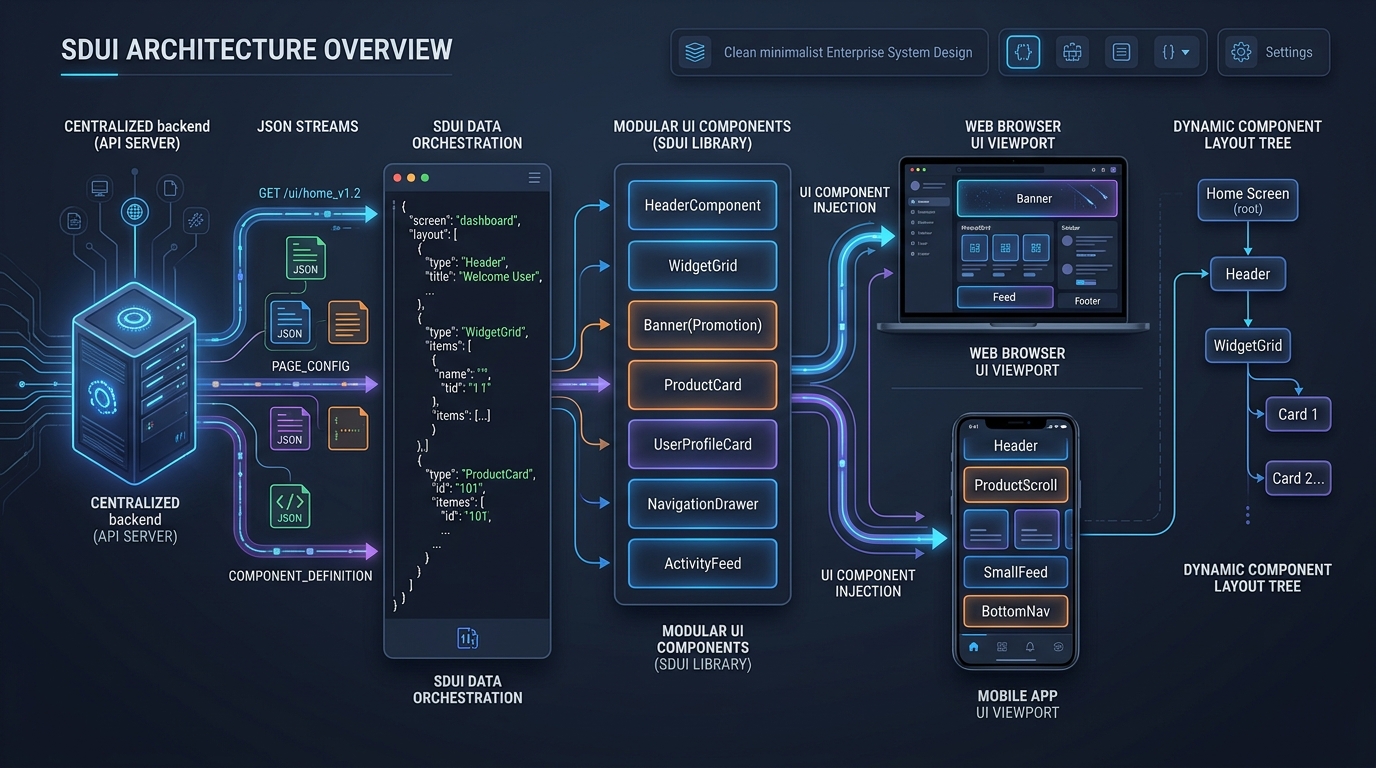
Server-Driven UI (SDUI) has evolved from an experimental mobile optimization at Airbnb, Lyft, and Shopify into the dominant architectural paradigm for multi-platform enterprise products in 2026. By centralizing UI layout logic, component hierarchies, and content orchestration within backend JSON schemas, engineering organizations completely bypass sluggish 7-day Apple and Google app store review cycles. When coupled with mature headless design systems built with component primitives like Radix and React Aria, SDUI enables cross-functional growth teams to run real-time UI experiments, reorder viewports, and deploy critical production UI hotfixes in milliseconds across web, iOS, and Android simultaneously.
For more than a decade, the relationship between backend APIs and frontend presentation followed a rigid contract: backend services delivered raw relational data (typically JSON entities like users, orders, or transactions), and frontend client applications (React on web, Swift on iOS, Kotlin on Android) contained hardcoded UI templates that determined how that data was visually rendered.
In 2026, this classical separation of concerns creates severe enterprise bottlenecks. A minor layout change, a seasonal promotional banner, or an updated onboarding sequence requires three separate engineering teams to coordinate releases, followed by agonizing multi-day delays waiting for app store gatekeepers to approve binary builds. Server-Driven UI (SDUI) shatters this paradigm by shifting UI orchestration from client-side code directly into backend schemas.
What Is Server-Driven UI (SDUI) Architecture and How Does It Work in 2026?
Server-Driven UI (SDUI) is an architecture where backend API responses define not just the data, but the complete visual component hierarchy, layout structure, and action bindings of the interface. Native client applications act as rendering engines that parse JSON schemas and dynamically instantiate pre-compiled design system component primitives.
Under an SDUI architecture, the client application ceases to be an opinionated collection of static pages. Instead, the native web or mobile client operates as a deterministic runtime engine—analogous to a web browser rendering HTML. The client binary contains a rich library of design system components (buttons, cards, carousel trays, form fields, and navigation bars). When a user navigates to a screen, the backend delivers a schema specifying: “Render a HeroBanner with ID 101, followed by a TwoColumnGrid containing three ProductCards, followed by a StickyBottomCTA.”
This architectural shift aligns directly with modern design systems and headless component architectures explored in our teardown of shadcn/ui vs. Radix vs. React Aria headless component tokens and our guide on enterprise activity timelines.
Architectural Comparison: Traditional Client-Side UI vs. Server-Driven UI (SDUI)
Understanding the tradeoffs between client-rendered applications and server-orchestrated architectures is crucial for Chief Technology Officers and Principal Design Strategists evaluating this transition:
| Evaluation Vector | Traditional Client-Side UI | Server-Driven UI (SDUI) 2026 | Strategic Impact |
|---|---|---|---|
| Deployment Velocity | Slow (3–7 day App Store reviews, staggered releases) | Instant (Sub-second backend schema deployment) | Instantaneous A/B testing and emergency UI bug fixes |
| Cross-Platform Parity | Prone to drift across Web, iOS, and Android codebases | Guaranteed (Single schema drives all client runtimes) | Eliminates visual fragmentation across mobile and desktop |
| Client App Size | Grows exponentially with every new screen and view | Constant (Only base component primitives are bundled) | Smaller download sizes and higher mobile conversion |
| Offline Capabilities | High (Templates cached locally; only data is fetched) | Requires schema caching and deterministic offline defaults | Demands disciplined local-first caching architecture |
| Engineering Complexity | Low upfront; high long-term maintenance overhead | High upfront schema design; near-zero long-term release friction | Massive ROI for high-iteration products and marketplaces |
The Anatomy of a 2026 Production SDUI JSON Schema
In modern enterprise SDUI systems, schemas must be strictly typed using JSON Schema, Protocol Buffers (protobuf), or TypeScript types. The schema separates three core concerns: Component Identity, Visual Properties & Tokens, and Action Dispatch Handlers.
{
  "screen_id": "checkout_review_v2",
  "version": "2026.04",
  "layout": "vertical_stack",
  "components": [
    {
      "type": "BannerAlert",
      "id": "promo_banner_spring",
      "props": {
        "title": "Spring Enterprise Discount Applied",
        "description": "20% deducted from your annual subscription.",
        "variant": "success",
        "icon": "shield-check"
      }
    },
    {
      "type": "DataTableCard",
      "id": "pricing_summary_table",
      "props": {
        "header_title": "Seat Allocation",
        "density": "compact",
        "source_endpoint": "/api/v1/workspaces/seats"
      }
    },
    {
      "type": "PrimaryButton",
      "id": "submit_order_action",
      "props": {
        "label": "Confirm Subscription & Activate Workspace",
        "variant": "indigo_solid",
        "full_width": true
      },
      "actions": {
        "on_click": {
          "action_type": "MUTATION_DISPATCH",
          "endpoint": "/api/v1/billing/commit",
          "optimistic_transition": "SHOW_CONFIRMATION_MODAL"
        }
      }
    }
  ]
}
Notice how the schema does not describe raw CSS styles like margin: 12px or color: #6366f1. Doing so would turn SDUI into a messy remote browser. Instead, the schema passes semantic design tokens (variant: "indigo_solid", density: "compact"). The client’s native design system maps those tokens to platform-specific primitives, ensuring complete fidelity and touch ergonomics.
Schema Governance, Version Fallbacks & Graceful Degradation
SDUI version fallback governance requires the client runtime to implement strict unrecognized component handling. When an older native mobile app receives a schema featuring a newly deployed component type, it must cleanly skip the unknown node or render a designated fallback container without crashing the application view.
The single greatest operational danger in Server-Driven UI is backward compatibility. Unlike web browsers where users instantly receive the latest bundle on page refresh, mobile users frequently run binary versions that are 6 to 18 months old. If the backend deploys a new component type (e.g. Interactive3DSlider) and sends that JSON to an app version compiled before that component existed, the parser will throw an unhandled exception and crash.
Enterprise SDUI platforms solve this with three mandatory defensive engineering guardrails:
- The “Ignore Unknown Components” Parser Guard: The client-side parser must be programmed to silently ignore unknown component types rather than halting execution. If a node is missing from the local component dictionary, the runtime skips it and continues rendering sibling nodes.
- Server-Side Client Version Negotiation: Client applications send their binary version and supported component capability list in HTTP headers (e.g.,
X-Client-Version: 4.8.2andX-SDUI-Capabilities: BannerAlert,DataTable,StickyCTA). The backend layout engine evaluates these headers and conditionally serves an older fallback schema to legacy clients. - Local Fallback Views: Every major container component defines an explicit fallback primitive (e.g. falling back from an interactive carousel to a standard horizontal link list).
People Also Ask: Server-Driven UI (SDUI) in Enterprise Architecture
Does Server-Driven UI hurt web performance and Core Web Vitals?
When implemented poorly, SDUI can introduce an extra network round-trip that delays First Contentful Paint (FCP) and Largest Contentful Paint (LCP). However, modern frameworks eliminate this penalty by server-side rendering (SSR) the initial SDUI JSON schema into HTML on edge CDN nodes (e.g., Cloudflare Workers or Next.js Edge Runtime), streaming pre-rendered HTML to the browser with zero client hydration delay.
Which companies use Server-Driven UI in production?
Server-Driven UI is utilized in production by major global technology organizations including Airbnb (pioneers of the Lona design system), Lyft, DoorDash, Uber, Shopify, and Spotify. These platforms rely on SDUI to dynamically tailor home feeds, checkout flows, and seasonal promotional banners across millions of concurrent users without requiring app store updates.
Is Server-Driven UI different from headless CMS?
Yes. A headless CMS typically delivers raw editorial content (text, blog posts, images) to be rendered by fixed frontend templates. In contrast, Server-Driven UI delivers the layout structure, component types, visual styling tokens, and interactive action handlers that build the complete application interface itself.
Server-Driven UI is the ultimate convergence of design systems and backend architecture. By elevating UI layout and component orchestration into backend schemas, enterprise organizations liberate their product and design teams from the tyranny of 7-day app store release cycles. The result is an agile, multi-platform machine capable of real-time personalization, instant UI experiment rollouts, and zero-downtime hotfixes that compound enterprise software velocity.