
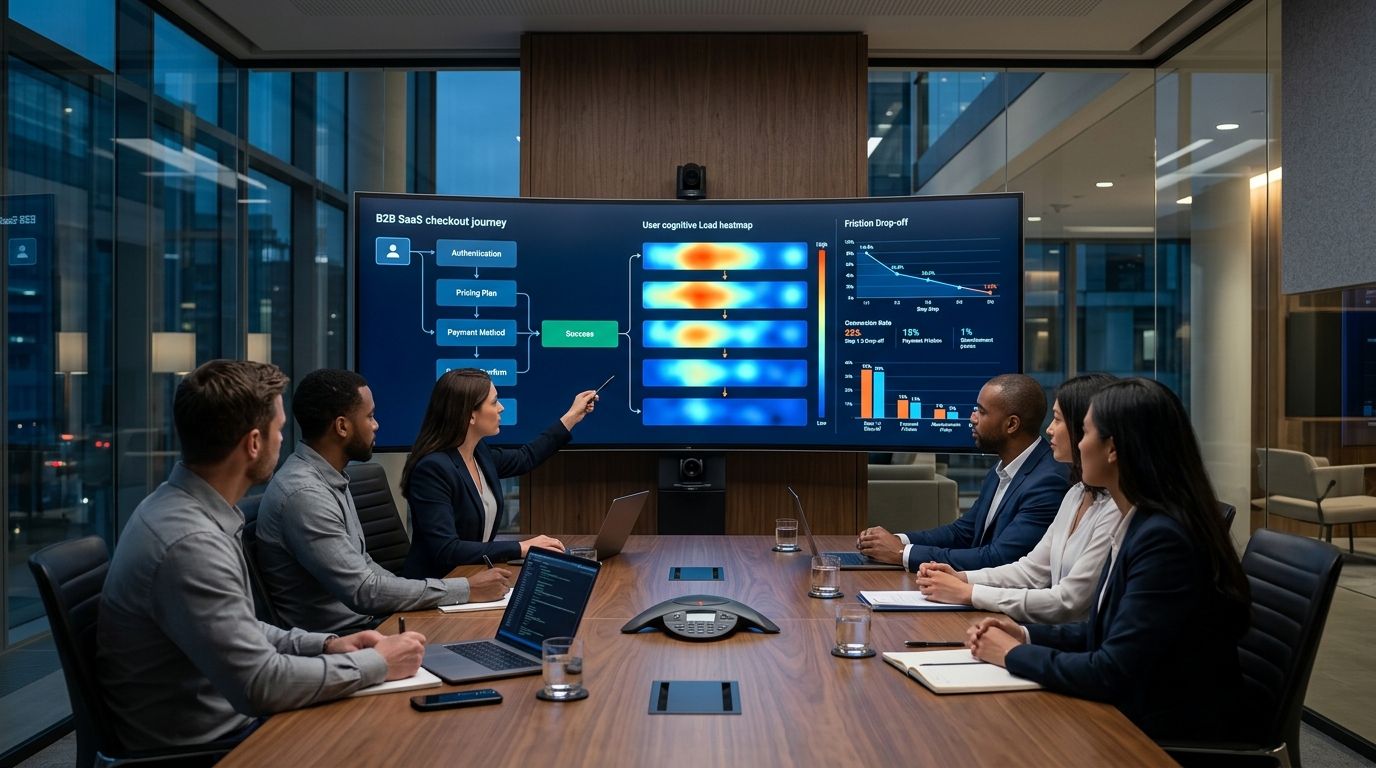
While consumer e-commerce checkout funnels (Shopify, Stripe Checkout, Apple Pay) have spent a decade relentlessly optimizing for one-click simplicity, enterprise B2B SaaS purchasing remains notoriously broken. High-ticket software buyers are routinely subjected to opaque seat calculators, mandatory “Contact Sales” hurdles, fractured invoicing forms, and sudden security authentication wall traps. In 2026, enterprise software companies lose an estimated $100 million in ARR annually not because their product lacks market fit, but because their checkout architecture imposes intolerable cognitive friction at the moment of transaction.
- The Drop-Off Catalyst: 68% of enterprise self-serve buyers abandon transactions when pricing tiers do not calculate total taxes, seat tiers, and usage caps in real time.
- Security Authentication Traps: Forcing corporate buyers to create ad-hoc passwords instead of integrating native SAML/SSO at checkout causes 22% of enterprise cart abandonments.
- Self-Serve Hybrid Funnels: Providing instant credit-card, ACH, and automated PO invoice generation within a unified UI boosts enterprise checkout completion by 31%.
As explored in our executive directives on evaluating headless architecture and digital infrastructure ROI, designing calm, low-cognitive-friction interfaces, and the financial risks of inaccessible enterprise UX, checkout conversion is the definitive litmus test of digital product leadership.
1. The Four Fatal Friction Points in Enterprise SaaS Funnels
- 1. Hidden Tier Calculations: Requiring enterprise procurement managers to manually multiply team seats by feature add-ons without an interactive, real-time pricing visualizer triggers purchase paralysis.
- 2. Fractured Invoicing & VAT/Tax Validation: Enterprise buyers rarely use personal credit cards; they require automated corporate VAT/GST tax validation, custom billing addresses, and downloadable pre-purchase PDF quotes for departmental budget approval.
- 3. Sudden Authentication Walls: Inserting an unexpected, multi-step email verification loop in the middle of payment data entry breaks user momentum and drives immediate session abandonment.
- 4. Opaque Cancellation & Seat Proration Terms: Ambiguous language regarding auto-renewals, annual lock-ins, or mid-cycle seat additions creates buyer hesitation that stalls procurement sign-off.
2. Conversion Architecture: High-Friction vs. High-Velocity Funnel
Enterprise B2B SaaS Checkout Funnel Comparison (2026 Conversion Metrics)
| Funnel Attribute | Legacy High-Friction SaaS Checkout | High-Velocity Enterprise Funnel (2026) |
|---|---|---|
| Seat & Tier Pricing Display | Static tables with separate add-on calculator | Interactive dynamic slider with instant total annual/monthly cost |
| Payment Method Flexibility | Credit card only (Rejects corporate purchasing cards) | Credit Card, ACH Wire, Apple/Google Pay & Instant Net-30 PO Invoice |
| Enterprise Identity Integration | Separate manual username/password creation | One-click corporate Okta/Google Workspace SSO provision |
| Checkout Funnel Completion Rate | 34% – 42% (High abandonment) | 68% – 76% (+32% Revenue Uplift) |
| Sales Assist Acceleration | “Book a Demo” wall forces 3-week sales delay | Self-serve checkout with embedded instant chat for custom contract terms |
3. The 2026 Executive Action Checklist
To eliminate checkout leaks and unlock latent ARR, product and design executives must execute three immediate optimizations: embed instant invoice and tax generation directly inside the payment modal, support native corporate SAML/SSO provisioning prior to payment submission to secure organizational buy-in, and replace punitive multi-step forms with an accordioned, single-page summary view that transparently communicates prorated seat upgrades and annual billing discounts.
Evaluating global tax compliance, merchant of record mechanics, and friction-free payment flows? Read our complete forensic breakdown of Stripe vs. Paddle vs. Lemon Squeezy Checkout Interaction Design to compare sub-second address autocompletion, VAT calculation latency, and mobile payment conversion rates.
People Also Ask
What is cognitive friction in UX design?
Cognitive friction occurs when an interface demands excessive mental effort, confusion, or decision-making from a user to complete a task, leading to frustration, errors, and task abandonment.
Why do B2B SaaS checkout funnels have high abandonment rates?
B2B SaaS checkouts frequently fail because they lack corporate payment options (ACH/Invoicing), hide tax and proration fees until the final step, and force complex authentication before completing the transaction.
How can enterprise software companies improve checkout conversion rates?
By offering transparent real-time pricing sliders, instant corporate tax/VAT validation, one-click enterprise SSO provisioning, and multi-option payment rails (Credit Card, ACH, and Net-30 Invoices).