
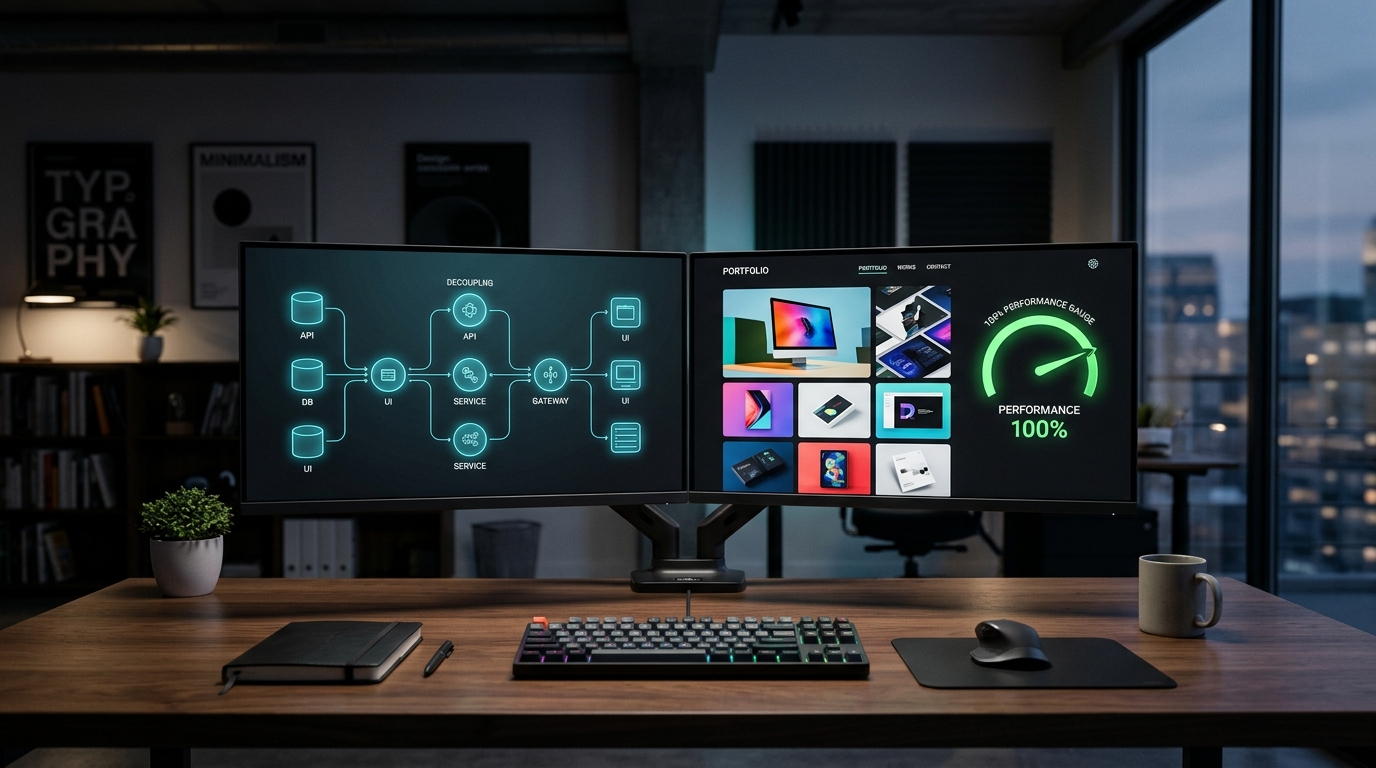
For executive leadership teams, marketing directors, and enterprise business owners in 2026, the traditional monolithic website stack has reached its breaking point. For over two decades, WordPress powered the web by coupling its content management database, PHP rendering engine, and frontend theme into a single monolithic server environment. However, as digital brands scale across complex marketing ecosystems, this legacy architecture creates crippling technical debt: 40+ third-party plugins, bloated visual page builders, failing Google Interaction to Next Paint (INP) Core Web Vitals, and persistent security vulnerability alerts. Modern enterprises are resolving this friction through Headless Decoupled Architecture.
When Should an Enterprise Migrate to Headless WordPress?
Content editors maintain their familiar Gutenberg editing experience, while engineering teams gain full freedom to craft ultra-fast, modern React frontends without battling legacy PHP rendering bottlenecks.
| Architectural Dimension | Monolithic WordPress Stack | Decoupled Headless Stack (Next.js / Edge) | Executive Advantage |
|---|---|---|---|
| Global TTFB & Speed | 450ms – 1,200ms (PHP rendering latency) | 25ms – 45ms (Global CDN Edge Caching) | 10x Faster First Byte Response |
| Core Web Vitals (INP / LCP) | Fails INP due to heavy plugin JS bundles | 100% Green Scores (<50ms INP, <1.2s LCP) | Maximized Google SEO Ranking |
| Security Attack Surface | Exposed PHP endpoints, MySQL, wp-login attacks | Zero public PHP/DB surface; static static assets | Virtually Unhackable Frontend |
| Traffic Spike Scalability | Requires vertical server scaling & DB replication | Serverless edge distribution absorbs 10M+ hits | Zero Downtime During Surges |
| Content Distribution | Tied to website theme HTML templates | Omnichannel GraphQL feeds to web, mobile, SaaS | Single Source of Truth |
How Does Headless Decoupling Guarantee Sub-Second Global Speed?
By eliminating heavyweight monolithic plugins (Elementor, Divi, Slider Revolution), headless frontends ship 80% less JavaScript over the wire, guaranteeing instant Interaction to Next Paint (INP) responsiveness even on budget mobile hardware.
Why Does Decoupling Eliminate the #1 Vector for Enterprise Web Breaches?
Over 90% of WordPress security vulnerabilities originate in third-party plugins and exposed administrative interfaces. Headless architecture neutralizes these threats by design:
- Air-Gapped WordPress Core: The WordPress CMS database and admin panel reside in a private virtual cloud (VPC) with zero public internet routing, accessible only through authenticated VPN tunnels or single sign-on (SSO).
- Static Edge Immunity: The public-facing frontend consists strictly of static assets and serverless functions with no database connection strings or PHP runtime interpreters, rendering SQL injection and cross-site scripting (XSS) impossible.
- DDoS Absorption: Traffic surges and distributed denial-of-service attacks hit edge CDN caches rather than origin servers, keeping origin compute costs flat.
What Is the Modern Tech Stack for Enterprise Headless WordPress?
Leading enterprises combine the content governance of WordPress with the frontend power of modern web technologies:
- Backend CMS: WordPress Core deployed with
WPGraphQLandFaust.jsor custom webhooks to provide high-performance typed API endpoints. - Frontend Framework: Next.js 15+ (App Router) or Astro for zero-JS static payload generation and edge middleware rendering.
- Hosting & Edge Delivery: Origin CMS hosted on hardened bare-metal servers, with the frontend edge cached across Cloudflare Workers or Vercel.